Practical Statistics for Biomedical Researchers: From p-values to Survival Curves

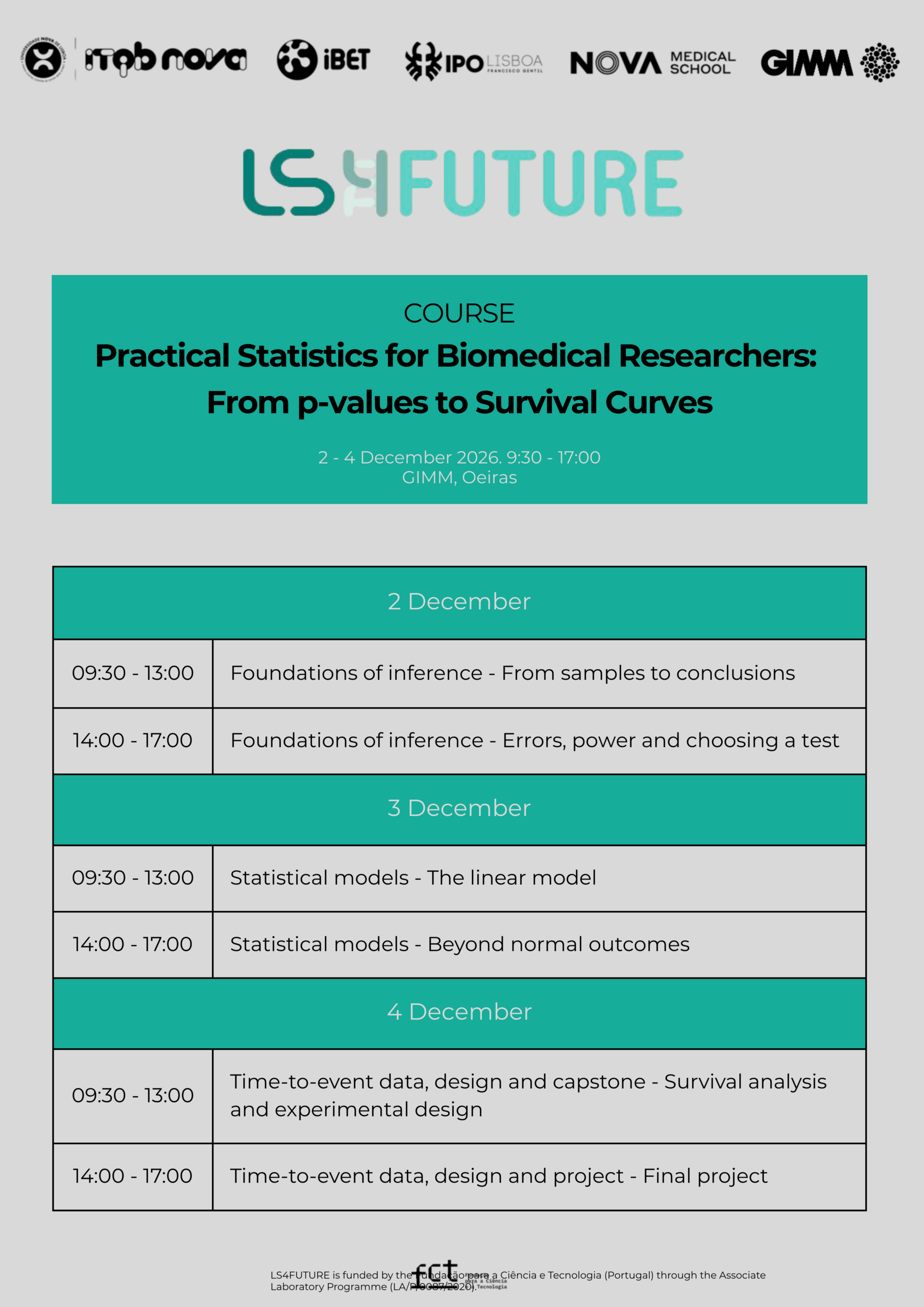
Click right on the image to see the full progam
Statistical decisions shape every experiment, from how many replicates to run to which test goes in the paper. Yet many researchers apply methods without being sure they fit the data or the question. This three-day hands-on workshop gives researchers in molecular biology and biomedicine a working understanding of the core statistical ideas behind everyday analyses, so they can choose methods with confidence and interpret results correctly.

Participants work in Google Colab with real datasets: a breast cancer clinical trial (GBSG2), an RNA-seq experiment on airway smooth muscle cells, and a lung cancer cohort. The code is provided, so the focus stays on reasoning and interpretation rather than programming, with the option of using AI assistants to help run and explain analyses. The workshop moves from the foundations of inference (confidence intervals, p-values, errors and power) to linear and generalized linear models, survival analysis and experimental design, and ends with a less-guided capstone analysis.

No coding experience is required. Participants should have basic familiarity with statistical concepts (e.g., means, standard deviations, the idea of a hypothesis test).

Bring a laptop with a Google account.

WHEN:

2 to 4 December, from 09:30 to 17:00.

Lunch won’t be provided. You can have lunch at the cafeteria at GIMM. If you prefer to bring your own food, microwaves are also available there.

WHERE:

GIMM Oeiras. Bioinformatics Training Room

Rua Quinta Grande, Oeiras, Portugal.

Main Learning Outcomes: 

By the end of the workshop, participants will be able to:

  1. Interpret confidence intervals and p-values correctly, and recognize common misinterpretations.
  2. Explain Type I and Type II errors and use simulation to estimate the statistical power and sample size of a planned experiment.
  3. Choose an appropriate test for common research questions (two groups, paired data, proportions, non-normal data) and state its assumptions.
  4. Recognize t-tests and ANOVA as special cases of the linear model, and fit and interpret regression models with multiple predictors and interactions.
  5. Extend regression to binary and count outcomes using generalized linear models, including the negative binomial model behind RNA-seq differential expression.
  6. Explain why multiple testing inflates false positives and apply false discovery rate control.
  7. Analyse time-to-event data with Kaplan–Meier curves, log-rank tests and Cox regression, and interpret hazard ratios correctly.
  8. Identify design problems such as pseudoreplication, confounding and batch effects, and use blocking to improve an experiment.

This session is organized by GIMM’s Advanced Data Analysis team in collaboration with LS4FUTURE Laboratory, supported by the Education & Training Unit at GIMM.

The main trainer will be Tiago Paixão (GIMM).

Tiago holds a PhD in Biomedical Sciences from the Universidade do Porto / ICBAS and a degree in Physics Engineering from Instituto Superior Técnico. He also completed postdoctoral research in evolutionary genetics at IST Austria and the University of Houston. Tiago led the Quantitative Biology and Digital Science at the Instituto Gulbenkian de Ciência (IGC) and served as Head of Clinical Research at ImageBiopsy Lab, where he worked on medical AI software. In his current role at GIMM, he is leading a team specializing in experimental design, Bayesian inference, multi-omics data integration, andsingle-cell/spatial transcriptomics, alongside developing agentic AI architectures for biological databases.

REGISTRATIONS

Free, but mandatory.

Please go to GIMM website for registrations: https://gimm.idloom.events/Practical_Statistics_for_Biomedical_Researchers