Registrations Open: LS4FUTURE Course in Multi-Omics Data Analysis
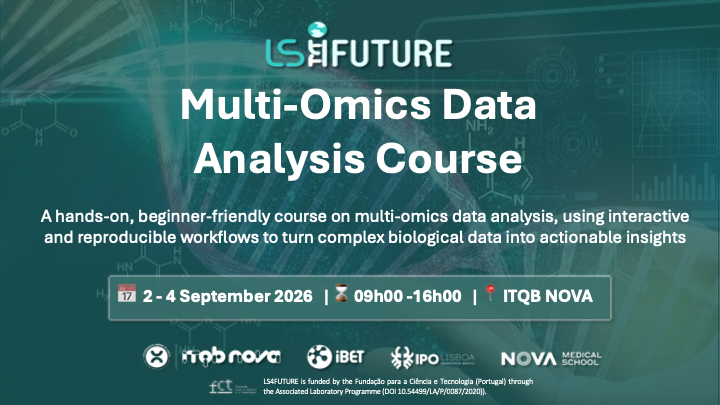
We are pleased to announce that registrations are now open for the upcoming LS4FUTURE Course in Multi-Omics Data Analysis, taking place from September 2 to 4, 2026, from 09:00 to 16:00, at ITQB NOVA.
LS4FUTURE Multi-Omics Data Analysis Course
📅 Dates: September 2 to 4, 2026
📍Place: ITQB NOVA
Registrations here (deadline: 13 August)
This course builds on the recent LS4FUTURE information session “Graph-Based Data Science for High-Impact Omics”, where the community was introduced to the scNotebooks framework, a new generation of open-access, interactive training resources designed to make omics data analysis more accessible, reproducible, and hands-on. Developed as multilingual Jupyter Notebooks, scNotebooks enable researchers to work with real datasets through guided workflows and live coding, directly from their own laptops using cloud-based environments such as Google Colab.
Following the session, the LS4FUTURE community was invited to participate in a survey to help shape the course content. Based on this input, the selected focus for this edition is Multi-Omics Data Analysis, reflecting a strong interest in approaches that integrate multiple layers of biological data to generate meaningful insights.
Course Overview
This intensive, hands-on training is designed primarily for PhD students and postdoctoral researchers, as well as researchers aiming to strengthen their data analysis skills, even with limited programming experience. The course will cover:
- Core concepts in multi-omics data analysis
- Integration of proteomics, metabolomics, and other omics data types
- Practical, step-by-step workflows using the scNotebooks framework
- Interactive analysis of real datasets
- Reproducible research practices
The course follows a theory-to-practice approach, combining conceptual understanding with guided implementation.
If you would like to participate:
- No advanced coding skills required
- No need for high-performance computing infrastructure
- Hands-on, interactive learning with real data
- Immediate applicability to ongoing research projects
Places are limited, and early registration is recommended (deadline: 13 August).
Join us for this opportunity to advance your data science skills and explore multi-omics analysis through an accessible, practical, and reproducible framework.